



Octi presents ‘Ammonite’ SS27, exploring water, fossils and the passage of time
London-based jewellery designer Octi has presented Ammonite, its Spring/Summer 2027 collection inspired by water, fossil forms and the natural patterns that survive across time. The collection continues founder Octi Ransom’s exploration of the golden ratio in nature, using ammonite fossils found along rivers and coastlines as its central reference. OCTI SS27 PRESS RELEASE
For SS27, water becomes both subject and process. Octi considers its ability to erode and preserve, gradually reshaping ancient surfaces while leaving the ammonite’s defining spiral intact. The designer translates that transformation into precious-metal objects with salt-worn textures, satin finishes and fluid sculptural forms.
Sapphires appear as captured droplets of water, introducing points of colour and light across the collection. Meanwhile, existing Octi designs return with altered proportions, finishes and textures. Interchangeable rings can also be stacked and layered, allowing wearers to build their own combinations.




Natural geometry shapes Ammonite
Spirals, concentric forms and repeated patterns run throughout Ammonite. These elements connect the jewellery to structures found across the natural world, where apparently irregular forms often follow underlying mathematical systems.
That relationship between nature and geometry has long informed Octi’s practice. However, SS27 expands the idea beyond jewellery itself and into sound, movement and spatial design.
For the presentation, Octi collaborated with sound and spatial designers Robin Sparkes and Bojan Kostović. Together, they created an immersive environment that examines the relationship between material, space, sound and time.
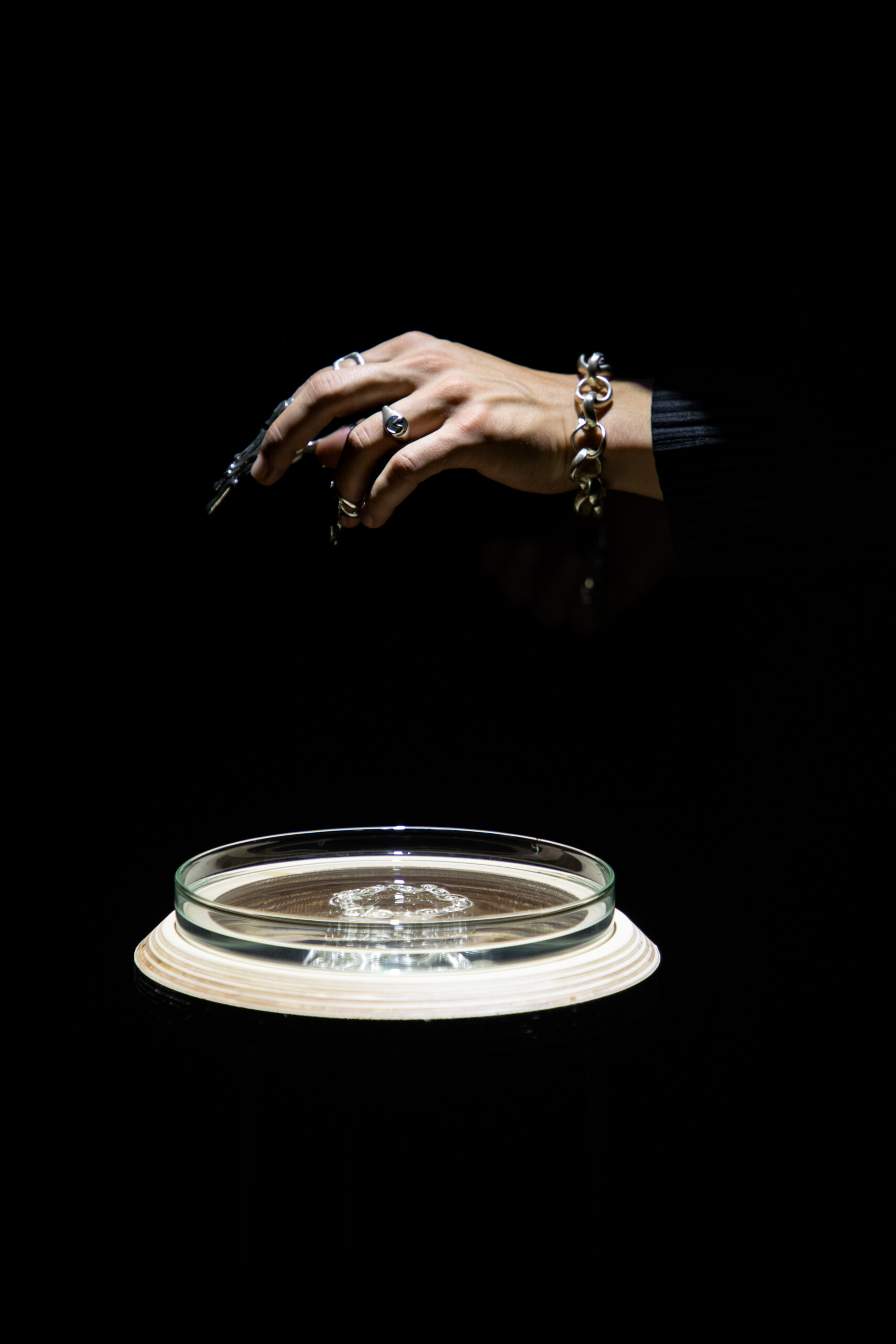
At its centre is a sculptural instrument holding cymbals made by Octi. The cymbals are played using dripping silver finger caps, while a live cymatics performance uses water to make sound visible.
Jewellery becomes sound and movement
The performance mirrors the way Octi creates jewellery. During the casting process, wax captures liquid movement at a single moment before metal preserves that form permanently.
In Ammonite, the same principle moves into sound. The instruments turn something temporary and invisible into a physical experience, creating what the brand describes as a crossover between seeing sound and hearing jewellery.
The presentation also references the Music of the Spheres, connecting geology, mathematics and music through rhythm, repetition and proportion. Fossils and sound become parallel forms: both shaped by pattern and time, but positioned at different ends of permanence.
As a result, Ammonite extends Octi’s interest in preservation beyond objects worn on the body. Water, movement and sound become part of the same material language, while jewellery acts as a record of moments that might otherwise disappear.
Octi continues its exploration of nature in precious metal
Octi Ransom founded the Hackney-based brand in 2022. Its jewellery translates fragments of the natural world into precious metals, with erosion, decay and human interaction providing recurring sources of inspiration.
The studio uses several processes to preserve these details. Some pieces begin with moulds taken directly from natural objects such as rocks, while others feature hand-engraved patterns and textures. For Octi, jewellery provides a lasting way to hold forms that would otherwise continue to change.
Octi Ransom led the creative direction for Ammonite. Robin Sparkes and Bojan Kostović created the sound and spatial design, while Kevin Adorni handled metal instrument fabrication. Fishdream Productions produced the cast aluminium cymbals, Jada Ellize worked on nail art and Morgan Layla Williams photographed the project. Blonstein handled show production, with Village overseeing press and Le Labo providing fragrance sponsorship.
Through Ammonite, Octi brings together jewellery, geology and performance in a study of how natural forms change and survive. The collection uses precious metal not simply as decoration, but as a material capable of recording texture, movement and memory.