




Fashion & Beauty 3 min read
Global Fashion Collective brought four international designers to London Fashion Week SS27
Global Fashion Collective brought four designers from Germany, France, Italy and Lesotho to London Fashion Week SS27 at Protein Studios in Shoreditch.
Automatic copying is unavailable. Select and copy this address.
Global Fashion Collective presented four international designers during its Spring/Summer 2027 London showcase on 20 September 2026. Held at Protein Studios Shoreditch as part of the official Fashion Scout London Fashion Week schedule, the programme brought together Spiky Cherry from Germany, Oscuro from France, ME maria elena di terlizzi from Italy and Joachim from Lesotho.
The collective presentation moved across crochet, streetwear, couture, tailoring and cultural craft, giving each designer a separate runway identity while placing four different international practices within the same London Fashion Week programme.
Spiky Cherry turned competitive performance into ‘Manufactured Grace’
Berlin-based designer Anna Tchashin, founder of Spiky Cherry, presented Manufactured Grace, a collection shaped by her past as a competitive ice dancer.
For SS27, Tchashin examined the tension between beauty, discipline and physical strain. Crochet became a sculptural material rather than a purely decorative technique, with hand-combined yarns, raw edges, fragmented surfaces and deconstructed construction wrapping and distorting the body.
The collection drew on the controlled repetition and scrutiny associated with elite performance. At the same time, punk and goth references disrupted that polished surface.
Softness operated almost as armour. Delicate handcraft sat against tougher subcultural codes, allowing Manufactured Grace to move between elegance and discomfort, performance and vulnerability.


Oscuro made its London debut with ‘UMBRA’
French label Oscuro, founded by self-taught designer Xavier Lopez, made its London debut with UMBRA.
The Spring/Summer 2027 collection developed the house’s established deep-black palette through a colder and more structured direction. Precise tailoring met premium streetwear, while urban utility and darker proportions defined the overall silhouette.
Construction remained central to the collection. Rather than relying on obvious decoration, Oscuro placed emphasis on fabric, cut, texture and detail.
The meaning of UMBRA was deliberately left open, allowing individual looks to communicate through form rather than a fixed narrative. The London presentation marked the label’s first opportunity to bring its visual identity to a London runway.


Maria Elena Di Terlizzi transformed memory into couture
Italian designer ME maria elena di terlizzi presented RYO King of Green, a personal tribute to Ryo, a friend and writer whose street art appeared on train carriages travelling from Apulia across Europe.
The collection connected haute couture techniques with the visual energy of graffiti. Magenta, green and metallic silver appeared alongside sharply defined gradients inspired by Ryo’s murals.
Materials included soft georgette, silk and structured cady. Pleating referenced railway tracks, while hand embroidery, mesh weaving and bespoke hand-painted fabrics translated elements of the original graffiti into individual garments.
Rooted in tailoring traditions from Apulia, RYO King of Green brought together urban art and Italian craftsmanship. The collection used clothing as a way to preserve a personal connection while allowing the original imagery to move into a new medium.


Joachim brought Basotho culture to the runway
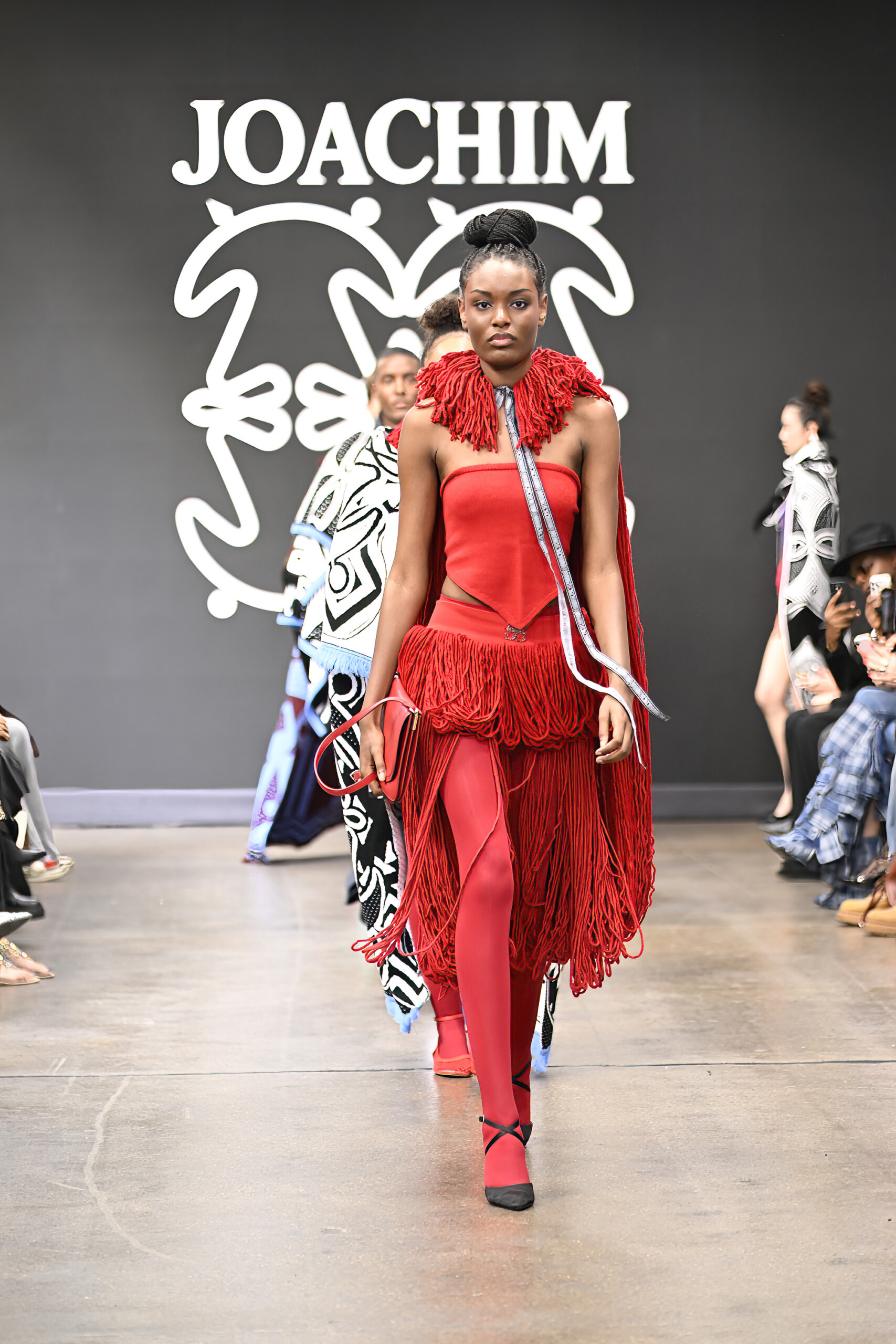
Founded in Lesotho by Katiso Joachim Tsoho, Joachim presented a collection grounded in Basotho cultural references.
The designer drew on Litema, the Thebe shield, the Mokorotlo, Mohobelo and Basotho blankets, translating these elements into contemporary patterns, knit structures, silhouettes, graphics and detailing.
The references appeared across knitwear, tailoring, outerwear and accessories. Rather than separating heritage from contemporary design, Joachim used traditional cultural codes as an active part of the brand’s current visual language.
The collection reflected the label’s aim of preserving identity while continuing to develop its craftsmanship for an international audience.



Four approaches to contemporary fashion
The London showcase demonstrated the range within Global Fashion Collective’s international programme.
Spiky Cherry transformed personal experience and performance into sculptural crochet. Oscuro approached contemporary menswear through dark tailoring and streetwear. Maria Elena Di Terlizzi used couture to preserve memory and urban art, while Joachim placed Basotho identity within contemporary luxury design.
Global Fashion Collective operates runway showcases across Tokyo, New York, London, Milan and Paris. The organisation works with international designers to increase visibility and create access to new fashion markets.
Its SS27 London edition used the Fashion Scout platform to bring four distinct cultural and creative perspectives together at Protein Studios, showing how craft, identity and personal history can translate differently across an international runway.
The publication
Keep reading.
Follow PROMINENT on Google.
More from PROMINENT
 Events21 October 2026
British Fashion Council names 50 NEW WAVE: Creatives for The Fashion Awards 2026
 Fashion & Beauty4 October 2026
Global Fashion Collective closes NYFW SS27 with six international labels at The Glasshouse
 Fashion & Beauty3 October 2026
Global Fashion Collective brings seven designers to New York Fashion Week SS27
Join the conversation below.
Leave a comment